The Tables That Traveled Here.
Some objects arrive in a bar as decor. Others arrive as evidence.
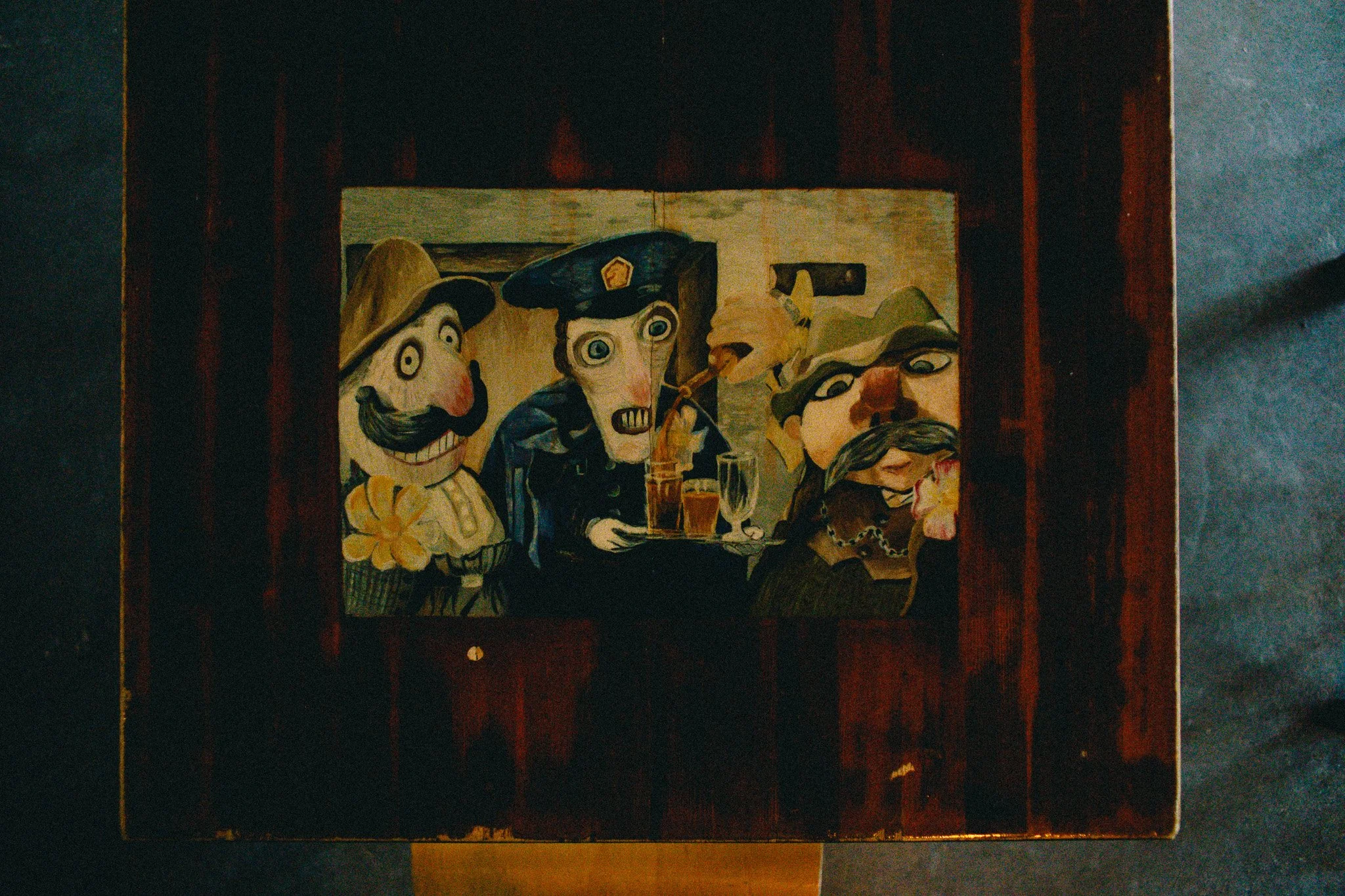
These two painted tables came to us with a story attached: that they were from the Czech lands, likely made in the 1970s, and that they depicted something out of Czech fairy tale culture. We cannot prove every part of that story. We do not have a maker’s signature, a town stamp, or a catalog entry tying them neatly to one artist or one village. But uncertainty is not the same thing as emptiness. In anthropology, objects are often most revealing when they sit somewhere between documentation and memory. They carry use, rumor, region, and habit all at once. These tables do that. They feel less like framed artworks displaced onto furniture, and more like fragments of a lived world that once expected art to sit under your glass, your elbows, your conversation. That matters. It tells us we are dealing not only with pictures, but with material culture.
The first clue is not the paint itself, but the fact that the paint is on a table at all. In the Czech lands, painted furniture has long belonged to the vocabulary of folk culture. The National Museum in Prague documents traditional folk culture across Bohemia, Moravia, and Silesia, and its ethnographic collections include roughly 1,400 pieces of folk furniture, including hand-painted examples. In Turnov, the Museum of the Bohemian Paradise describes painted furniture as one of the most valuable expressions of local folk culture. In other words, the idea that a functional object could also be a painted narrative surface is not odd in this context. It is traditional. The table was never merely a support structure. It was already a bearer of meaning.
That helps explain why these tables do not look precious in the gallery sense. They look inhabited. Their imagery is direct, theatrical, sometimes awkward, a little funny, and a little unsettling. One scene appears to place us in a tavern or beer hall, full of exaggerated faces, mask-like expressions, and a poured drink at the center. The other shifts outdoors, into a pastoral scene that still feels staged rather than natural, like a comic interlude happening just beyond the pub door. Neither image behaves like salon painting. Both behave like folk narrative. They flatten character into type. They exaggerate features until expression becomes social shorthand. They want to be read quickly, communally, and more than once.
This is where the fairy tale part of the story becomes useful, though not necessarily literal. I do not think these tables can be confidently tied to one specific Czech fairy tale. They look more like they belong to the wider visual world from which Czech fairy tales, folk humor, and puppet theatre all draw their energy. UNESCO describes Czech and Slovak puppetry as a form of traditional folk entertainment that also conveys a vision of the world and teaches moral values. VisitCzechia notes that Czech puppetry spread across various regions from the eighteenth century onward, that puppeteers often carved their own figures, and that a distinctive style emerged from the stiff motion of marionettes paired with highly stylized voice and gesture. Folk plays were built around recognizable comic and moral types. That puppet logic is all over these tables. The figures are not anatomical. They are performative. They look less like people than like roles.
That distinction matters. Fairy tale, in Central Europe, is not only a genre of printed stories for children. It is also a way of organizing social imagination. The village fool, the stern onlooker, the trickster, the drinker, the devil, the braggart, the man who takes himself too seriously, the woman who knows better, the whole pageant of human weakness and comedy, these are folklore’s working materials. Czech puppetry preserved many of those figures for generations, and amateur theatre remains deeply rooted in community life. So when someone says these tables depict fairy tales, I hear something slightly broader and perhaps more accurate: they depict a fairy-tale world, meaning a world where social truth is best told through caricature, ritual, and performance rather than realism.
The 1970s detail also makes sense, maybe more than it first appears. If these tables do come from 1970s Czechoslovakia, they belong to the long period known as Normalization, the era that followed the suppression of the Prague Spring. It was a period marked by political control, public conformity, and a retreat from reform, but it was also a period in which people continued to build meaning in the domestic and semi-public spaces around them. One recent study of late-socialist Slovakia, which must be used carefully here as a neighboring and federated context rather than direct proof about these exact tables, argues that amateur folk art was promoted as an ideologically acceptable way to bring pre-socialist rural traditions into modern socialist interiors and everyday life. That is a revealing frame. It suggests that handmade vernacular objects in a folkloric mode were not leftovers from some distant peasant past. They could still be actively made, circulated, taught, and domesticated in the late socialist period. Not despite modernity, but as one acceptable version of it.
Seen that way, these tables start to look less like quaint antiques and more like social documents. They may have been made by an anonymous craftsperson, an amateur painter, or a regional decorative artist working in a style that sat between folk revival, home craft, and pub furniture. The exact maker may be lost, but the form still speaks. It says that vernacular art did not disappear when the twentieth century arrived. It moved into kitchens, pubs, cottages, workshops, municipal culture, tourism, and memory. It remained in the places where people actually touched things.
And that brings us to drinking culture, because in Czechia the table makes the most sense once beer enters the frame. In 2025, the Ministry of Culture added Czech beer culture to the national list of intangible cultural heritage. The nomination emphasized not only brewing and hop-growing, but also the social role of pubs, tapsters, guests, and shared customs. The official language is striking: Czech beer culture connects the smallest rural pubs with major city taverns, supports gatherings and exchanges of opinion, and contributes to social cohesion. Kirin’s international beer report likewise shows that the Czech Republic remained the world leader in per-capita beer consumption in 2022, at 188.5 litres per person, the thirtieth consecutive year it held that position. Those numbers are easy to flatten into stereotype, but they point to something more interesting than quantity. They point to institutional depth. Beer in Czechia is not only a product category. It is an everyday social infrastructure.
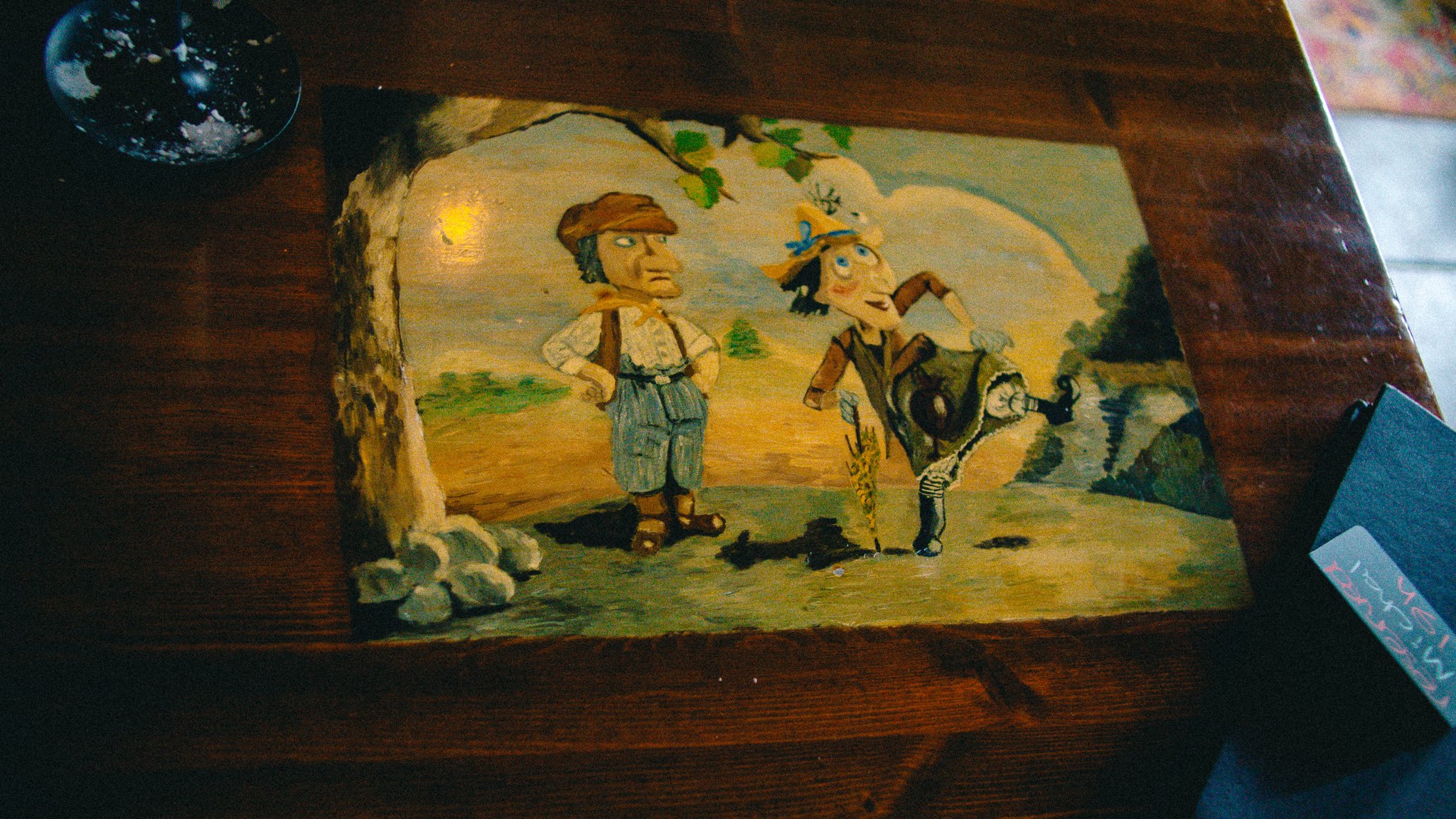
There is an old temptation, especially from outside, to treat Czech drinking culture as if its significance lies simply in abundance. But that misses the point. The pub, or hospoda, has historically mattered because it is one of the places where private life becomes collective without becoming official. It is where people gather without ceremony, where knowledge circulates laterally, where humor takes the edge off hierarchy, where memory can survive in the body long after it has vanished from institutions. The recent heritage language around Czech beer culture is useful precisely because it refuses to reduce beer to intoxication. It speaks instead about human togetherness, community, and the passing on of symbols and identity. That is a much richer description of why a drinking culture matters. It is not important because people consume a lot. It is important because it gives form to how people are with one another.
Under that lens, the painted table becomes a perfect pub object. Not a neutral surface, but the literal stage on which social life rests. Glasses ring it. Hands lean into it. Stories are repeated over it. Disagreements harden and soften across it. It acquires scratches, stains, and polish from use. When such a table is painted with comic faces, tavern scenes, and folk figures, it is doing something quietly brilliant. It collapses image and action into one object. It lets the life of the bar happen on top of a painted version of itself. Art is not hung at a distance, asking for reverence. It sits below the drink, asking for participation.
That may be the deepest reason these tables feel right at Slow Pour. We have never been especially interested in bars as mere consumption engines. What interests us is the old, difficult, beautiful idea that drinking can still be cultural without becoming pompous, and communal without becoming chaotic. Czech beer culture has always held that tension well. It knows that a poured lager can be humble and ceremonial at the same time. It knows that a pub can be ordinary and sacred in the same breath. It knows that the table matters. Not as furniture alone, but as a site of relation.
So when we say these tables belong here, we do not mean that in the decorative sense. We mean they belong here because they come from a world, or at least from the memory of a world, in which beer was not just sold, but staged socially. In which objects were expected to work harder than modern objects do. In which furniture could still carry folklore, humor, and local identity without apology. In which painted wood could absorb a century of habits more gracefully than a framed print ever could.
Maybe that is why they feel so alive in the room. They are not pristine. They do not flatter the eye in a clean, contemporary way. They are odd. Slightly crooked. Theatrical. A little haunted, in the best sense. They remind us that hospitality does not have to be frictionless to be meaningful. Sometimes it should carry a little texture. A little folklore. A little evidence that people came before us and sat long enough at a table to want more from it than utility.
We cannot yet name the painter. We cannot point to a single Czech fairy tale and say, this is the one. We cannot honestly claim a precise town of origin. What we can say is more modest and, in a way, more interesting. These tables fit within a real Czech and Moravian tradition of painted furniture, folk imagery, puppet-like character, and beer-centered social life. They make sense within the cultural weather of late Czechoslovakia. They make sense within a society that kept vernacular forms alive, even under pressure, and that continued to treat beer as a medium of togetherness rather than a disposable drink. And now, improbably, they make sense in Edmonton too.
That is the strange comfort of old objects. They do not need to be fully solved in order to belong. Sometimes belonging is exactly this: a table leaves one drinking culture, crosses an ocean and a few decades, and finds another room that still knows what a table is for.